Expert Tutorials
Code Examples
Industry Analysis
Best Practices

More from the Blog

Page 6 of 58, newest first. See the latest articles.

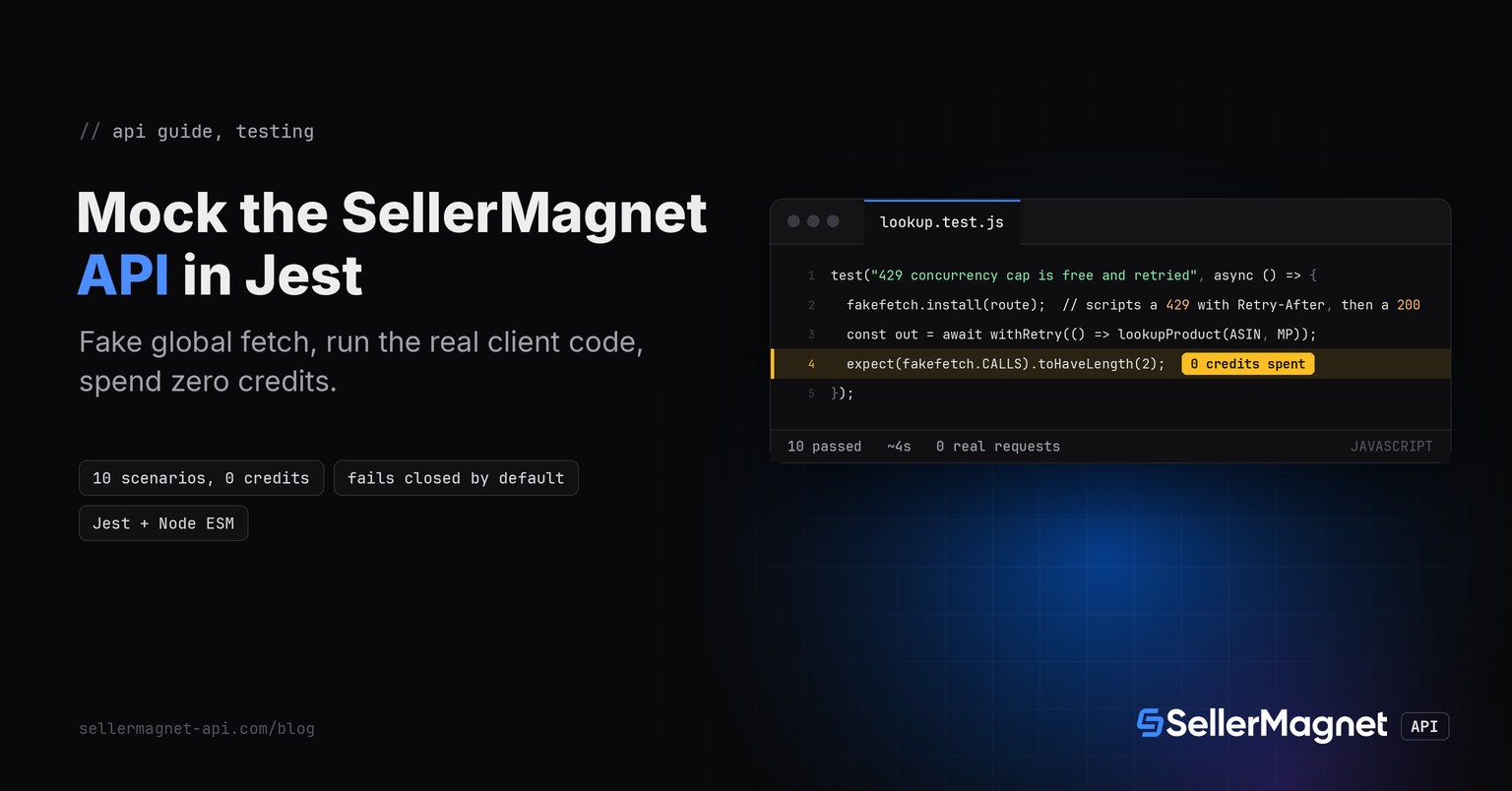
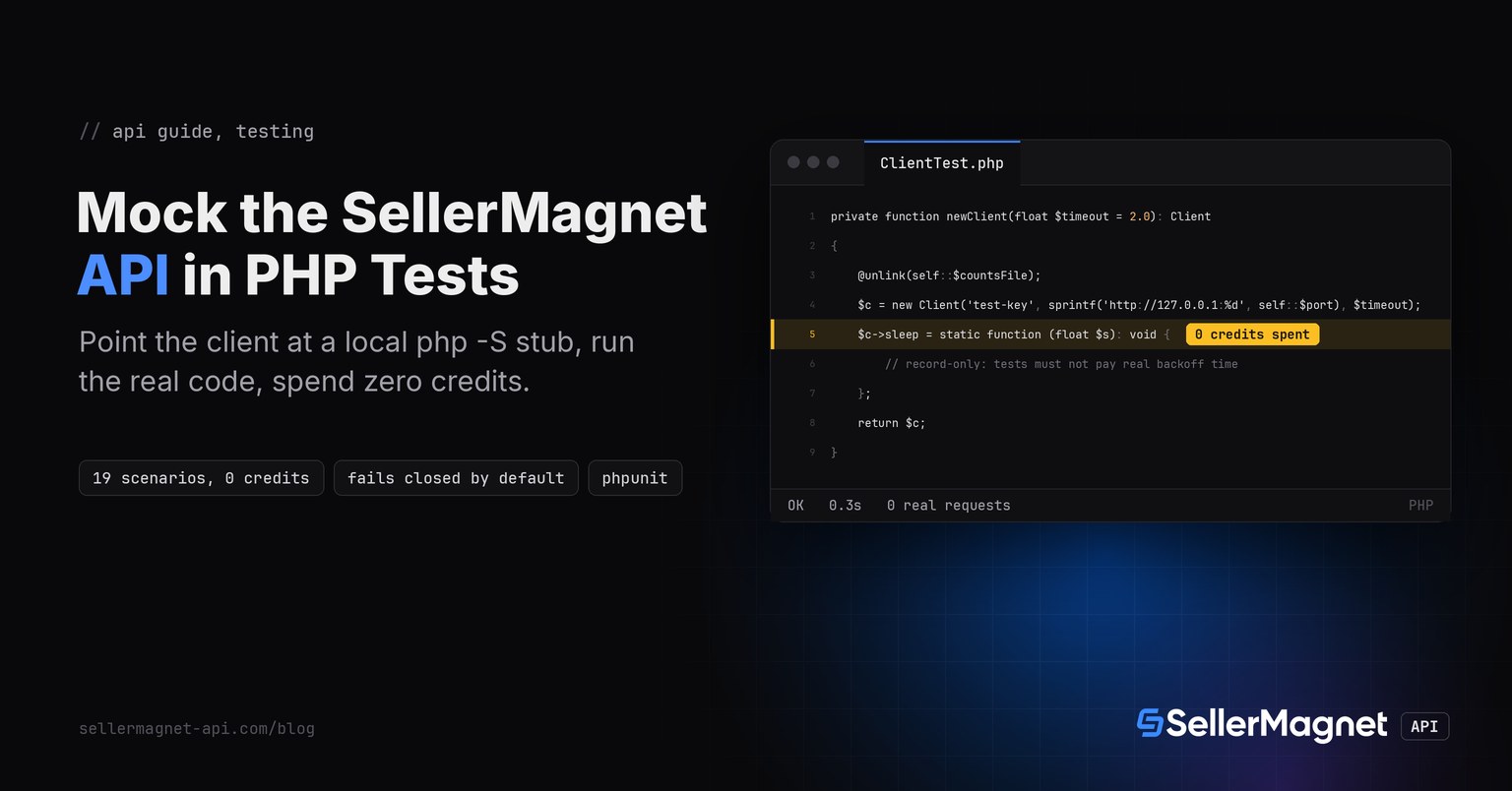
Terminal window showing a PHPUnit run that fakes the SellerMagnet API behind a local php -S stub while the real Guzzle client code runs unchanged

Mock the SellerMagnet API in PHP Tests Without Spending Credits

Test the Guzzle-based PHP client that calls the SellerMagnet API without hitting it: point Client.php's own base-URL test seam at a local `php -S` stub, run the real Client.php / Models.php / Retries.php from the PHP quickstart unchanged, and cover every billed, free and refunded status code with a 19-test PHPUnit suite that runs in under a second.
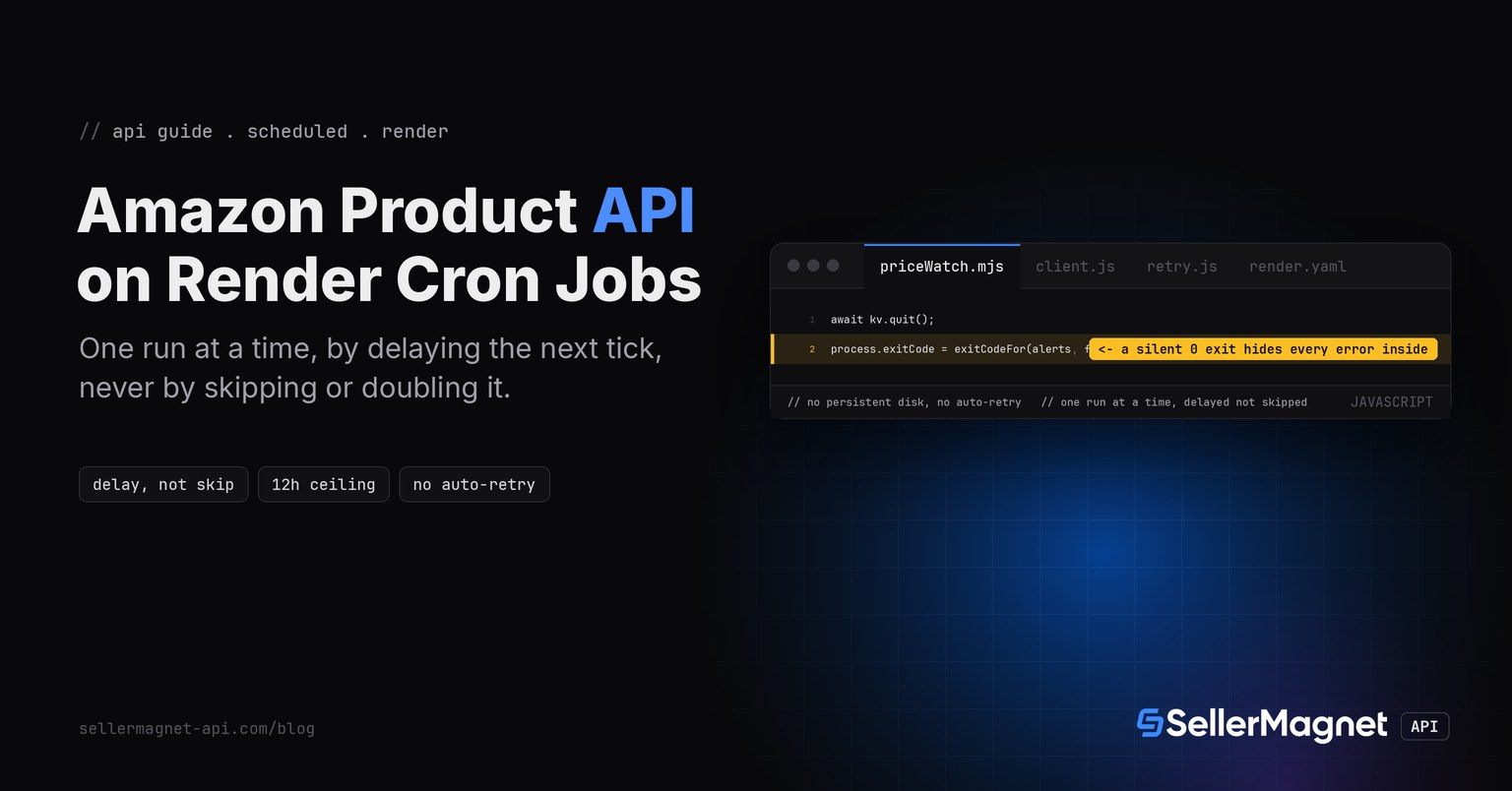
Terminal showing a Render Cron Job running a Node.js price-watch script against the SellerMagnet product lookup API

Amazon Product API on Render Cron Jobs: One Run at a Time, by Delay Not by Skip

Run an Amazon Buy Box price-watch as a Render Cron Job. client.js and retry.js need zero changes from the TypeScript quickstart. The real traps: Render guarantees exactly one run at a time by DELAYING the next tick rather than skipping it, it never auto-retries a failed run and tracks failure only by exit code, and a cron job can't touch a persistent disk at all, so the price baseline has to live in Render's own Key Value service.

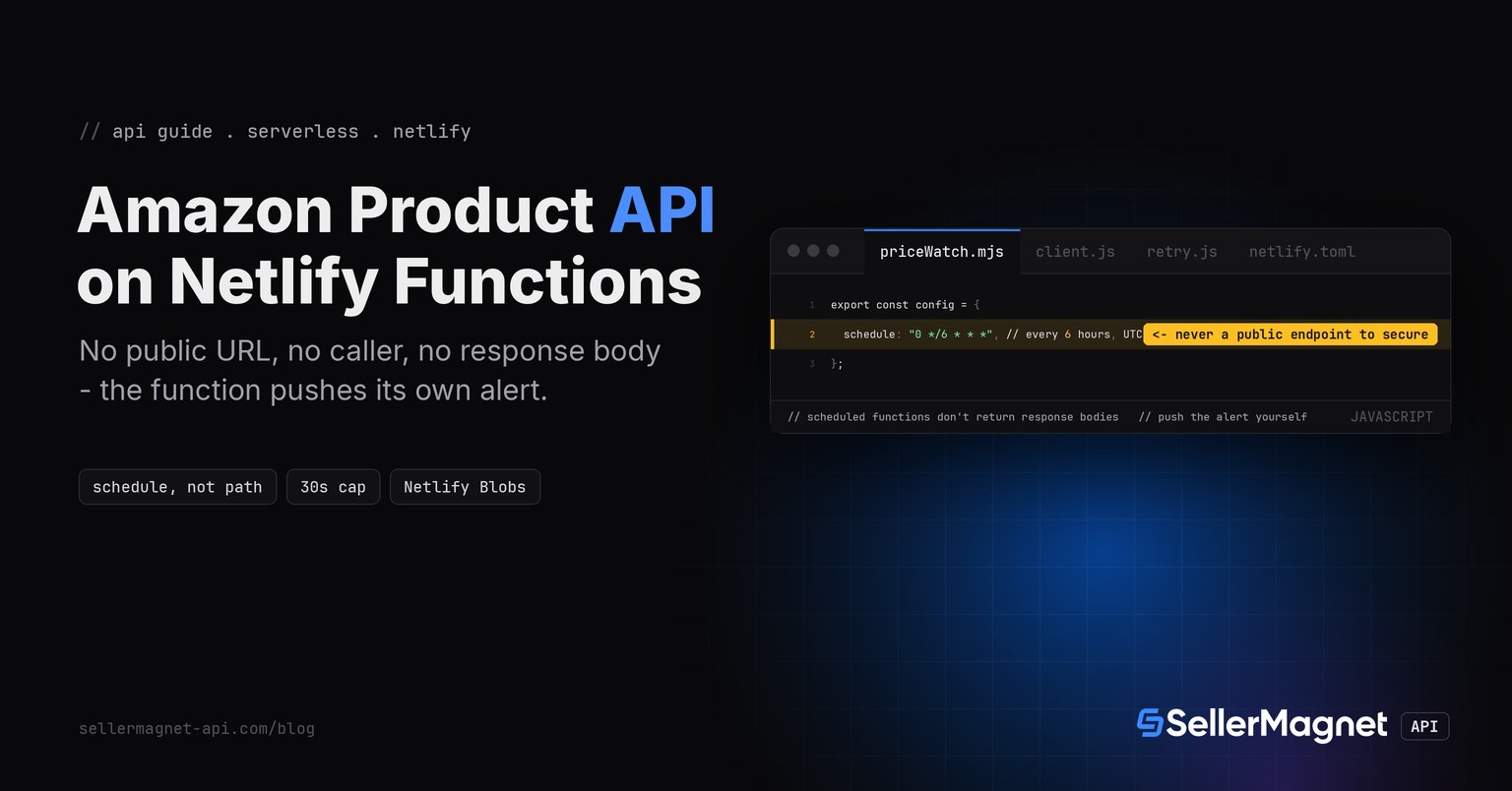
Terminal showing a Netlify Scheduled Function calling the SellerMagnet product lookup API and pushing an alert to a webhook

Amazon Product API on Netlify Functions: No URL, No Caller, No Shortcuts

Run an Amazon Buy Box price-watch on a Netlify Scheduled Function. client.js and retry.js need zero changes from the TypeScript quickstart. The real traps: a scheduled function has no public URL at all and only runs on published production deploys, it returns no response body so it has to push its own alert, and an API key rotated in the Netlify UI does nothing until the next deploy.

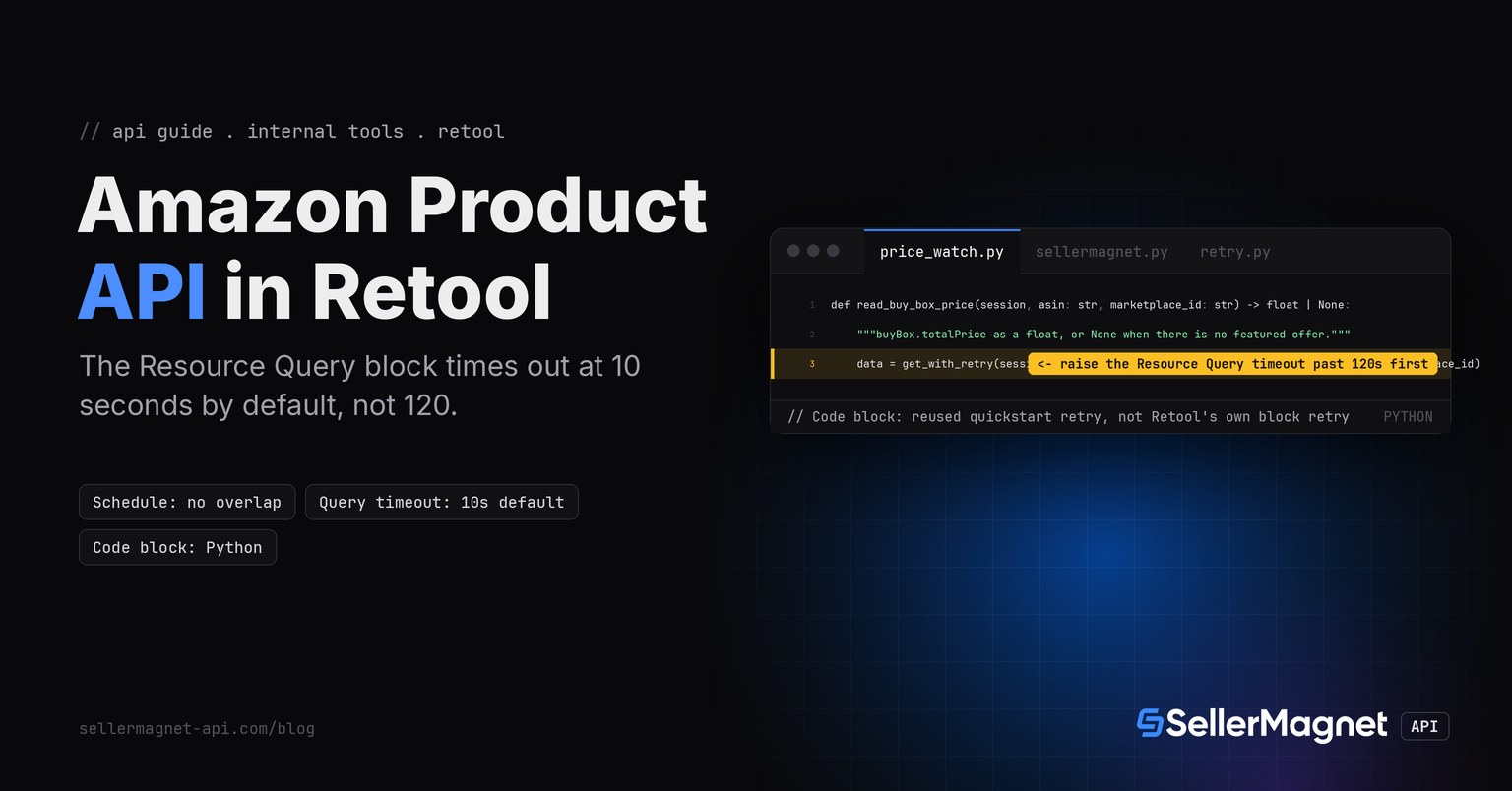
Terminal showing a Retool Workflow Schedule trigger calling the SellerMagnet product offers API

Amazon Product API in Retool: a Scheduled Price-Watch Workflow

Build an internal Amazon Buy Box price-watch as a Retool Workflow: a Schedule trigger, a REST API resource for the SellerMagnet call, and a Python Code block that reuses the quickstart's own sellermagnet.py/retry.py unchanged. The real traps: a Resource Query block times out at 10 seconds by default, far below the API's ~120-second allowance, and a scheduled run can never overlap itself, so a slow run only ever runs late, never twice.

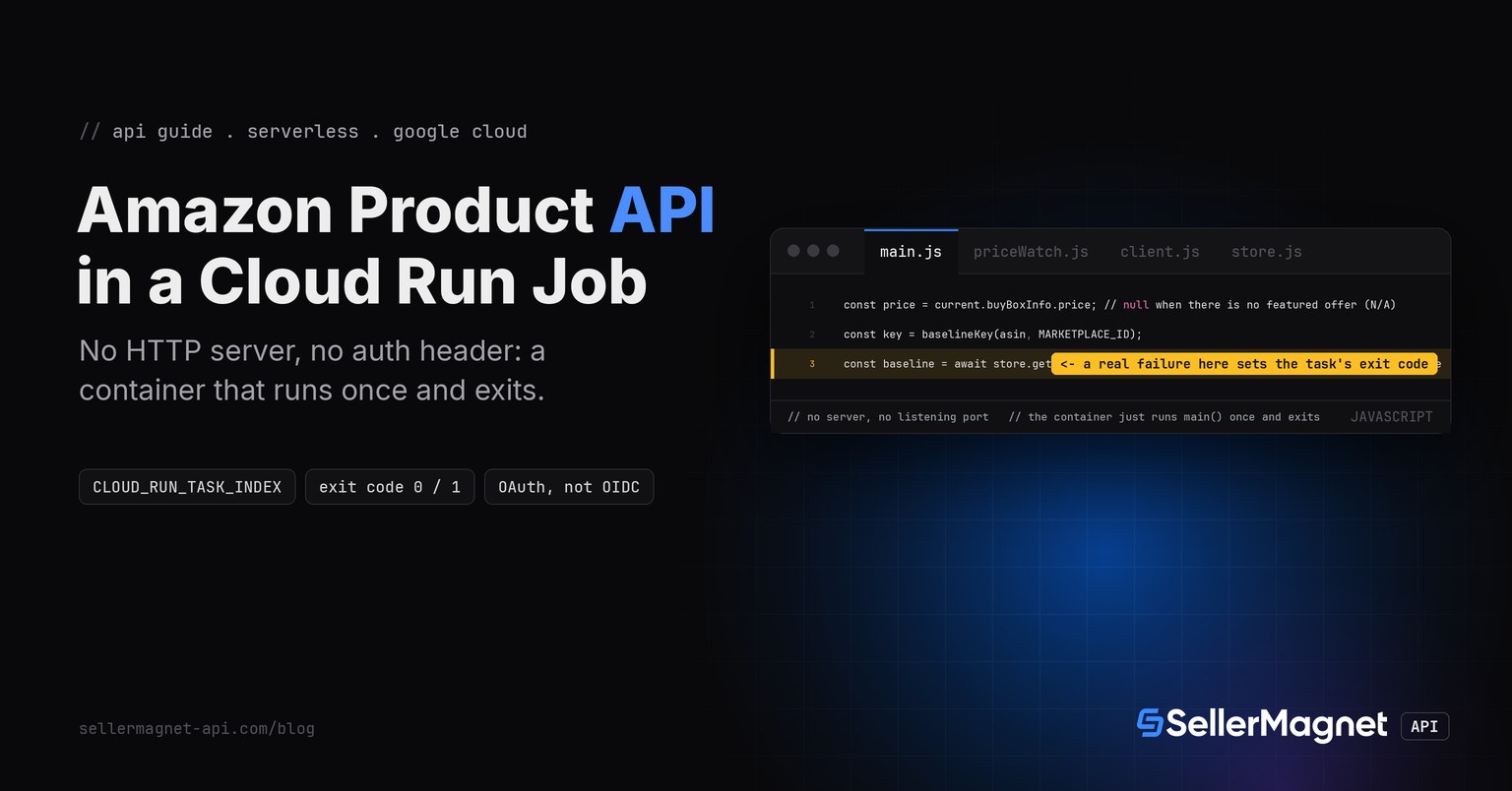
Terminal showing a Google Cloud Run Job task invoked by Cloud Scheduler calling the SellerMagnet product lookup API

Amazon Product API in a Google Cloud Run Job: No HTTP, No Auth Header

Run an Amazon Buy Box price-watch as a Cloud Run JOB, a container that runs to completion and exits rather than an HTTP server. client.js and retry.js need zero changes from the TypeScript quickstart. The real traps: the scheduler authenticates with an OAuth token to the Admin API, so there is no header for the job's own code to check, and the platform retries a failed task on its exit code, so the baseline write order keeps a retried task from re-firing an alert it already sent.

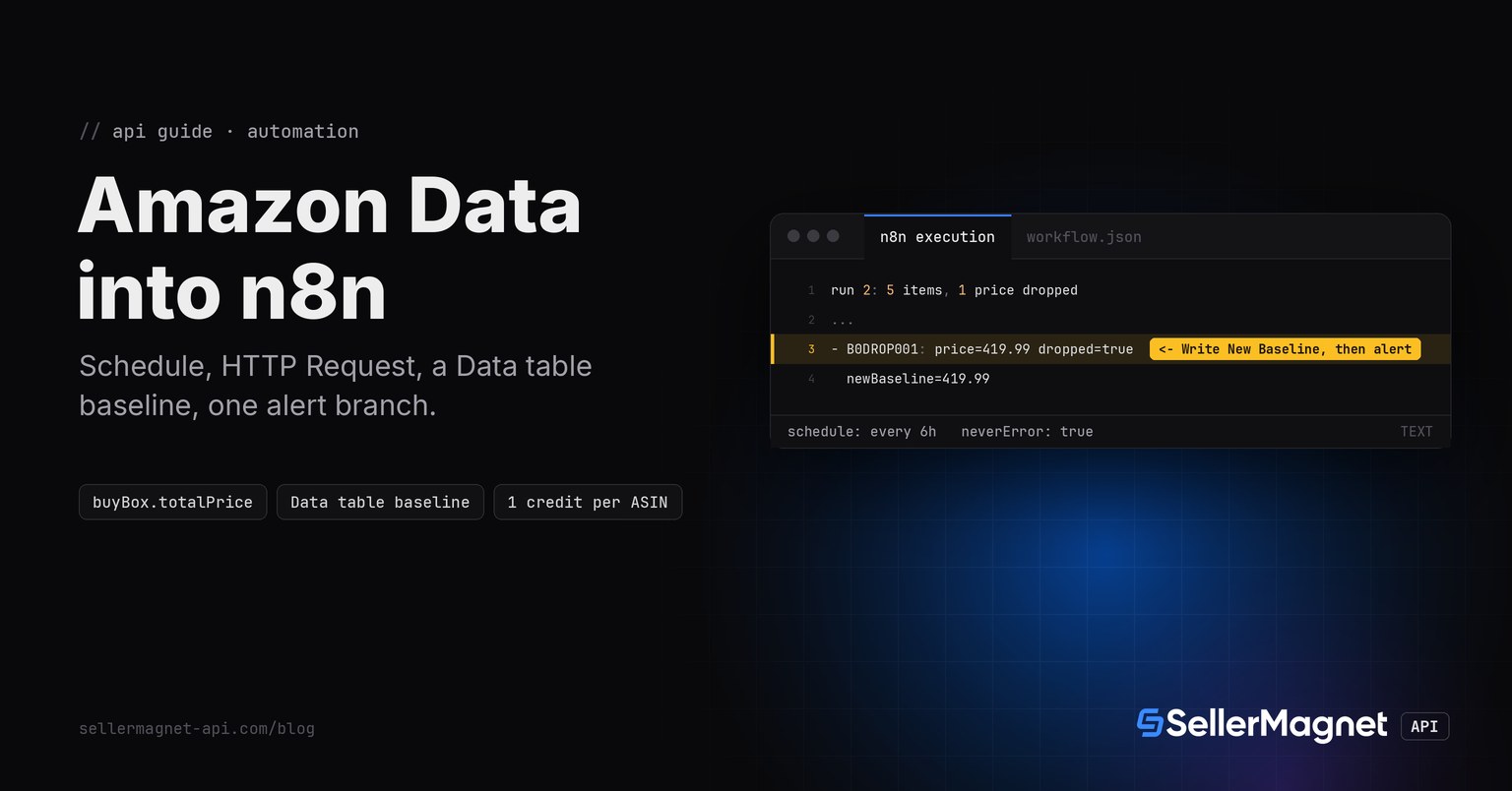
Terminal window running an n8n workflow that reports an Amazon Buy Box price drop

Amazon Product Data in n8n: HTTP Request Node, No Code

Pull Amazon product data into n8n with the HTTP Request node: a Schedule trigger, one call to /amazon-product-offers per ASIN, a Data table that holds the last known price, and an alert branch on a Buy Box price drop. Built and run twice in a real n8n instance, exported as an importable workflow JSON, not just unit-run JavaScript.

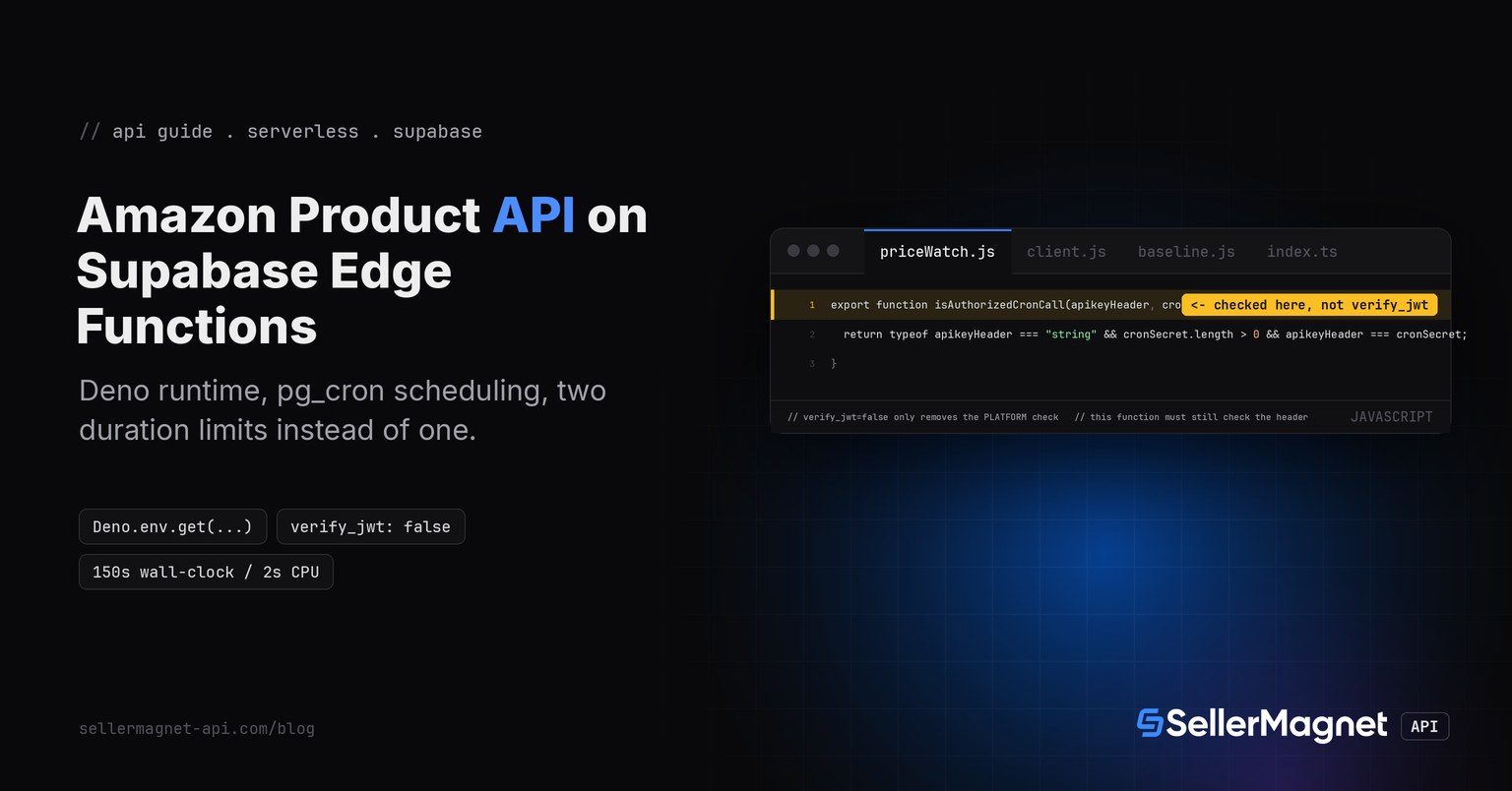
Terminal showing a Supabase Edge Function invoked by pg_cron calling the SellerMagnet product lookup API

Amazon Product API on Supabase Edge Functions: Two Limits, Not One

Run an Amazon Buy Box price-watch on Supabase Edge Functions, invoked on a schedule by pg_cron. retry.js needs no change at all; client.js needs exactly one line, reading the API key with Deno.env.get instead of process.env. The real traps: a scheduled call gets a silent 401 unless verify_jwt is explicitly off, and Supabase meters wall-clock duration and CPU time as two separate limits, so a CPU-cheap batch can still run out of real seconds.

Power Your Business with Amazon Data

Join thousands of developers using SellerMagnet API for real-time Amazon product intelligence. Start extracting data in minutes.

150 free API credits • No credit card required • Cancel anytime